Take your digital content to the next level using AiVOOV
One Click Text to Speech Solution
Read More
From virtual training to real-world tasks, discover how NVIDIA is helping developers build robots that can see, learn, and act.
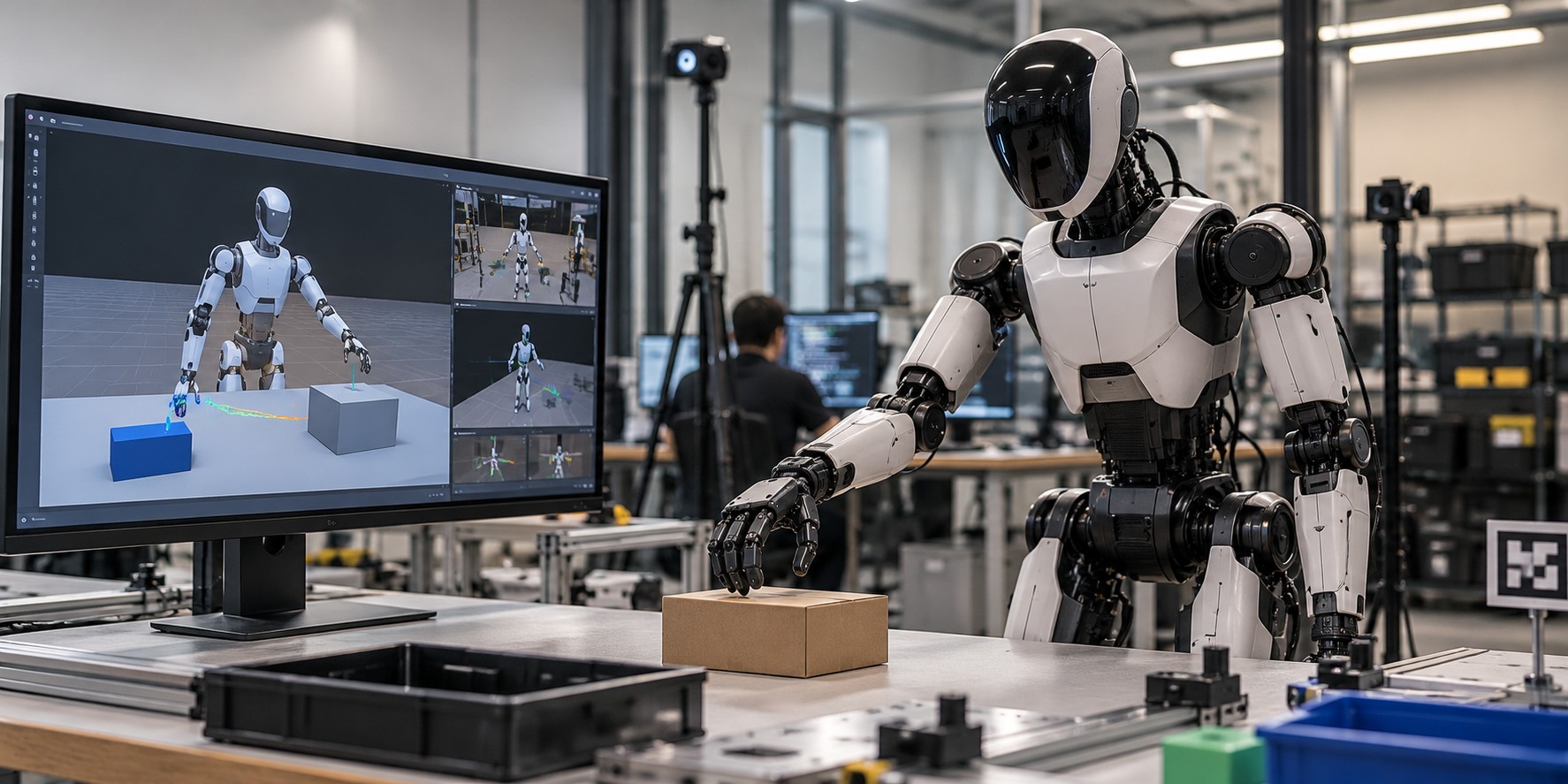
Imagine teaching a robot to pick up a box from a table. A person can watch the box, reach for it, adjust their grip, and lift it. A robot has to solve several problems first: identify the object, understand where it is, plan its movement, control its motors, and react if something changes.
This is one of the challenges NVIDIA is trying to address with its expanding Isaac open robotics platform. Announced at GTC Berlin on October 21, 2026, the update brings together new robot-learning software, simulation tools, datasets, a runtime framework, and a humanoid reference platform.
The important part is not just the robot itself. It is the development process behind it: how robots practise skills in virtual environments, how developers train their behaviour, and how those skills are tested before being used in the real world.
Understanding this process helps explain why the latest robotics announcements matter, even if you have never programmed a robot before.
A robot can have cameras, powerful processors, and moving arms and still struggle with an ordinary task. Hardware gives it the ability to sense and move, but it also needs software that connects what it sees with the action it should take.
Think about a robot working in a warehouse. It may need to pick up a package, avoid an obstacle, place the package on a shelf, and move on to the next item. If the package is in a different position or the shelf is partially blocked, the robot may need to adjust its behaviour.
Traditional automation often works best when the environment and task are carefully controlled. More adaptable robots need to handle a wider range of situations.
This is where AI-based robot learning becomes useful. Developers can train a robot's decision-making system using examples, demonstrations, simulated experiences, or a combination of methods. The goal is to help it respond to what is happening rather than follow only one fixed sequence of movements.
But learning a skill is only one part of the job. Developers also need a way to test it, connect it to the robot's hardware, and check that it behaves as expected outside the training environment.
NVIDIA's October 2026 announcement expands its Isaac robotics development platform. Instead of introducing just one robot or one AI model, the company is bringing together several parts of the development process.
| Technology | What it does | Why it matters |
|---|---|---|
| Isaac Lab 3.0 | Provides tools for training and refining robot behaviour in simulation. | Developers can train and test robot skills before trying them on physical hardware. |
| Isaac OS | Provides a runtime framework connecting AI, sensors, controls, and robot hardware. | Helps move software from development toward operation on a real robot. |
| SimReady Central Library | Offers more than 2,000 simulation-ready robotics and factory assets. | Gives developers reusable virtual objects and equipment for building simulation scenes. |
| Human 1M Dataset | Includes human activity data, synchronized three-view video, and 3D hand tracking. | Can support research and training involving human movements and interactions. |
| Agile ONE SN | A humanoid reference platform built on NVIDIA Isaac GR00T and powered by Jetson Thor. | Gives robotics researchers a more integrated system for developing and testing humanoid capabilities. |
These components solve different problems. Isaac Lab focuses on robot learning, Isaac OS focuses on running connected software on robot systems, and the reference humanoid gives developers a physical platform to work with.
The Human 1M Dataset also has an access distinction worth noting: NVIDIA says the full dataset is available to Cosmos Coalition partners. Developers should check the current dataset terms rather than assume every part is unrestricted.
Source: NVIDIA's official Isaac platform announcement.
Teaching a physical robot directly can be slow, expensive, and risky. A failed attempt to pick up an object may damage the object, the robot, or nearby equipment. Repeating an experiment also takes time because the physical environment has to be reset.
Simulation offers another approach. Developers create a virtual environment containing a robot, objects, surfaces, sensors, and other parts of the scene. They can then run experiments without requiring every trial to happen in the real world.
For example, a robot learning to pick up a box could practise with boxes in different positions, under different lighting conditions, and with different obstacles. Developers can observe its behaviour, adjust the training setup, and repeat the test.
NVIDIA Isaac Lab is designed to support robot-learning workflows like these. It provides a framework for training robot policies, which are systems that map observations to actions.
In everyday terms, a policy is part of the robot's learned decision process. It helps determine what the robot should do next based on what it senses.
To see how the pieces fit together, imagine a company developing a robot that needs to pick up packages from a workbench and place them into a container.
| Stage | What the team does | What it learns |
|---|---|---|
| 1. Build the scene | Create a virtual workbench, packages, containers, and robot model. | Whether the simulated environment represents the intended task. |
| 2. Train the skill | Run repeated grasping and placement attempts in simulation. | Which movements and actions lead to a successful result. |
| 3. Test variations | Change package positions, orientations, and other conditions. | Whether the learned behaviour handles variation or only one setup. |
| 4. Test on hardware | Run controlled trials with the real robot and real objects. | Whether the behaviour works with actual sensors, motors, and physical contact. |
| 5. Improve and monitor | Review failures and update the training or control system. | Where the system needs better reliability or additional training. |
This example is illustrative, not a claim that NVIDIA's announcement demonstrated this exact warehouse workflow from beginning to end.
The key idea is that simulation lets teams explore more situations before deploying a skill in a physical environment. It can reduce some development costs, but it does not remove the need for real-world testing.
A robot that succeeds in a virtual environment may still fail when it encounters a real object. This is one of the biggest challenges in robotics, often described as the sim-to-real gap.
In a simulation, the developer controls many of the conditions. In the real world, a camera may see a reflection differently, an object may be heavier than expected, a surface may have less grip, or a motor may respond differently from the simulated model.
Even small differences can affect the result. A simulated robot may appear to grasp a box correctly, but the real gripper may slip because the object's surface or weight is different.
Developers use several techniques to reduce this gap:
Simulation is a way to prepare a robot for reality, not a replacement for reality. The quality of the final system depends on how carefully the team validates it.
Alongside the software and training tools, Agile Robots announced Agile ONE SN, a humanoid reference platform designed for robotics research and development. It is built around NVIDIA Isaac GR00T and powered by the NVIDIA Jetson Thor platform.
NVIDIA's announcement lists several physical details that help explain the type of machine involved:
Degrees of freedom describe the independent ways a mechanical system can move. More degrees of freedom can allow more complex movement, but they also make control and coordination more challenging.
A humanoid reference platform gives researchers a physical system on which to develop, train, and validate robot capabilities. It is not evidence that the robot can already perform every household or factory task independently.
NVIDIA says Agile ONE SN is scheduled to become available in early 2027. That means the announcement should be understood as a development platform with a planned availability date, not as proof of widespread commercial deployment today.
The word open can mean different things in technology. It is worth checking exactly what is available before assuming a robotics platform is completely open source.
In NVIDIA's announcement, Isaac Lab is described as open source, and its developer documentation identifies the BSD-3-Clause license. This gives developers a clear starting point for reviewing the framework's licensing terms.
Other parts of the ecosystem have their own availability conditions. Hardware may be sold separately, datasets may have access restrictions, and individual models can have their own licenses.
For developers, an open robotics framework can offer several advantages:
Open software does not automatically provide free hardware, unlimited computing resources, or unrestricted access to every model and dataset. Always check the terms for the specific component you plan to use.
Developers can explore the official NVIDIA Isaac Lab page for framework details, documentation, and access to the open-source project.
The platform is relevant to more than humanoid robots. The same general development process can support different kinds of machines, although each robot needs suitable hardware, training, and control software.
These are potential application areas, not a guarantee that one platform can perform all these tasks out of the box. Each application has its own requirements for perception, movement, reliability, safety, and cost.
As robots become more capable, people will also need clear ways to communicate with them. A warehouse worker might want to ask a robot to bring a package, while a technician may need a spoken status update during a maintenance task.
Voice interaction is only one layer of a robotic system. Speech recognition helps a machine understand spoken instructions, an AI model may interpret the request, and a planning or control system determines which actions are allowed. Text-to-speech can then provide a spoken response.
These functions should not be confused with the robot's movement system. Generating a spoken response does not by itself make a robot capable of safely picking up an object or navigating a room.
For developers building videos, demonstrations, or narrated explanations of robotics projects, AiVOOV's AI voice generator can turn written scripts into voice narration. It is useful for explaining how a robotics workflow operates, while the robot's own control and interaction systems require their own technologies.
Technology announcements often combine software that developers can use today with hardware or features scheduled for a later date. Keeping those categories separate makes it easier to understand what the launch actually delivers.
| Component | Status reported in the announcement |
|---|---|
| Isaac Lab 3.0 | Generally available. |
| Isaac OS | Introduced as an open-source runtime framework; check current documentation for release and hardware support details. |
| SimReady Central Library | More than 2,000 simulation-ready assets announced. |
| Full Human 1M Dataset | Full access described as available to Cosmos Coalition partners. |
| Agile ONE SN | Planned availability in early 2027. |
Availability can change, so developers should confirm the latest documentation, downloads, licensing, and hardware requirements before planning a project around a specific component.
If you are a robotics researcher, Isaac Lab and its simulation workflows may be the most relevant place to start. If you build industrial automation systems, the connection between training, deployment, and physical hardware may be more important than the humanoid itself.
If you are a business owner, the practical question is simpler: do you have a repetitive physical task that is difficult to automate with conventional equipment? If so, robotics simulation can help your team explore whether an AI-driven approach is worth testing before investing in a full deployment.
And if you are simply interested in AI, this launch illustrates an important change. AI is no longer limited to writing text, generating images, or answering questions on a screen. Developers are building systems that connect AI models with sensors, software, and physical machines.
The next step is not to assume every robot will soon work like a human. It is to watch how reliably these tools help developers turn a narrow, carefully tested skill into something useful outside the laboratory.
One Click Text to Speech Solution
Read More
Explore NVIDIA's new AI models, their technical capabilities, and what they could mean for businesses, developers, and creators.
Read MoreWhat are you waiting for?
Create your account to generate realistic text-to-speech (TTS) audio with our online AI voice generator.
Try for Free